Space-Based Solar Power: Sci-Fi or the Future?
- Swaraj Bhatnagar
- Nov 20, 2025
- 3 min read
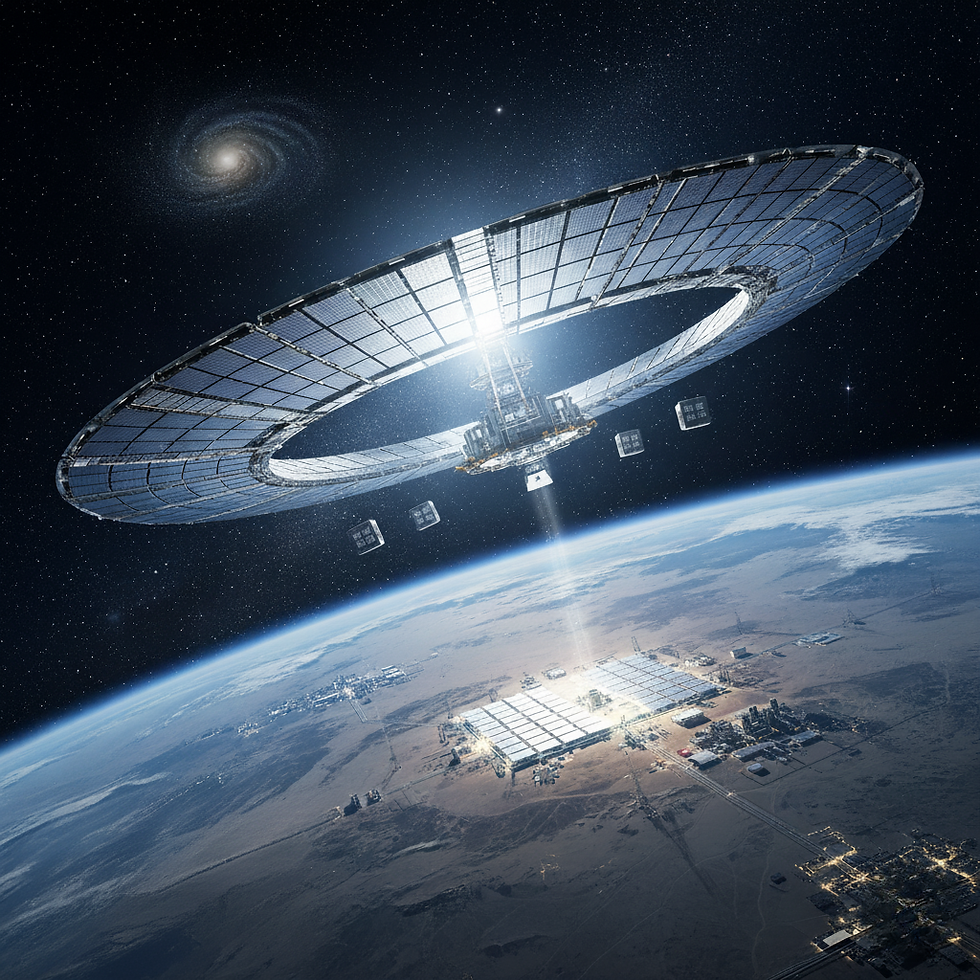
For as long as we’ve looked up at the sky, we’ve imagined ways to harness the endless power of the sun. Solar energy on Earth has grown rapidly, but it still has limits — cloudy days, night-time, weather patterns, and land availability all affect how much energy we can generate.
So what if we could collect solar energy without those limitations?What if solar power didn’t stop when the sun set?
This idea isn’t new. Scientists have been imagining space-based solar power for decades. Once considered pure science fiction, it’s now slowly shaping into real possibility.
What Is Space-Based Solar Power?
Space-based solar power (SBSP) is simple in concept:Collect solar energy in space, convert it into a usable form, and beam it down to Earth.
Because there is no atmosphere, clouds, or nighttime in space, solar energy can be captured continuously at far higher efficiency. Imagine a solar panel that never has to take a break — that’s the promise of SBSP.
How Would It Work?
The idea relies on a few key steps:
Large solar panels or solar satellites are placed in orbit.
These satellites capture solar radiation 24/7.
The energy is converted into microwaves or lasers.
That beam is directed to a receiving station on Earth.
The receiving station converts the beam back into electricity.
The process may sound futuristic, but several countries and companies are already experimenting with it.
Why Are Scientists So Interested?
1. Unlimited, uninterrupted solar power
Sunlight in space is much stronger than on the Earth’s surface, and it never gets blocked by weather or the seasons.
2. No land usage
Solar panels in space free up the land that would otherwise be needed for large solar farms.
3. Potential to power entire cities
If built at scale, a single solar satellite could supply massive amounts of clean power.
4. A long-term clean energy solution
As global energy demand rises, SBSP could become a sustainable way to meet the world’s needs without pollution.
Is It Really Possible?
This is where the conversation becomes interesting.Many countries, including the United States, China, Japan, and India, are actively researching SBSP. Engineers have already demonstrated small-scale microwave power transmission. Japan's space agency even conducted successful tests of wireless energy transfer.
However, several challenges remain:
Extremely high launch and construction costs
Need for lightweight, foldable solar panels
Safety considerations for microwave energy beams
Maintenance of large structures in space
While these hurdles are significant, technology is advancing rapidly. Just like smartphones and electric cars, what once seemed impossible eventually becomes everyday reality.
The Future: Closer Than We Think
Space-based solar power may not be powering our homes tomorrow, but it’s no longer a distant dream. As technology improves and the cost of launching satellites drops, the idea becomes more realistic.
Within the next decade or two, we may see the first functional solar power satellite sending small amounts of electricity to Earth. Over time, these systems could scale up, providing a continuous stream of clean energy.
What was once a sci-fi concept is slowly transforming into a future energy solution.
A New Era of Solar Innovation
Whether it’s rooftop solar, large-scale solar farms, solar reforming, or space-based solar power, the world is exploring every possible way to reduce carbon emissions and build a sustainable energy future.
At Ikaya Earth, we believe in embracing innovation that helps people live cleaner, healthier, and more efficient lives. Space-based solar power may be the future — but the journey toward clean energy starts right here on Earth, with the choices we make today.
Go Solar With Ikaya Earth
Contact: +91 9315879086
Website: www.ikaya.earth


Comments